A New Baseline for NFL Playing Surfaces: Inside the League's Mandatory Practices
Written by Eric O’Donnell
For more than five decades, field hardness testing in football has leaned on a familiar, if aging, toolkit — most notably variations of the Gmax-style impact test that trace back to the 1970s. That era could now be closing. The NFL and NFL Players Association, acting through the Joint Field Surface Safety and Performance Committee, have formalized a new framework: the Mandatory Practices for NFL Playing Surfaces (MPs). Written into the NFL-NFLPA Collective Bargaining Agreement under Article 39, Section 11, these eleven practices represent the most significant overhaul of field surface governance in the league's history — and for turf managers and sports scientists, they change both what gets measured and how.
From Guidance to Governance
Where prior surface guidance was largely advisory, the Mandatory Practices are exactly what the name implies: mandatory. They apply across every surface type used for NFL games and practices — synthetic turf, natural grass, and hybrid/reinforced systems — and cover impact hardness, infill depth and evenness, moisture content, cleat-surface traction, visual inspection, antimicrobial use, out-of-bounds surfacing, resodding protocols, new product screening, enhanced monitoring, and practice-field testing. Compliance is no longer a matter of professional discretion; it's tracked centrally through a new Field Surface Reporting System, with defined timing windows, pass/fail criteria, and remediation steps attached to each practice.
That shift alone is worth pausing on. Consistency has long been the elusive goal in surface management — a field that plays firm and predictable in Week 2 can behave very differently by Week 15, and a road team's practice surface has rarely been held to the same standard as the stadium it will play in. Mandatory Practicesclose that gap by requiring the same core tests, on the same schedule, using the same certified instruments, at every venue — game or practice, indoor or outdoor, domestic or international.
This could spell the end of the road for the old Hardness Test
The most consequential technical change is in Mandatory Practices 1: Impact Testing. In place of legacy hardness methodologies, the league has introduced a purpose-built device: the STRIKE surface impact tester. STRIKE is a portable, wireless, user-operated unit that releases a 11 lb instrumented missile from a fixed 1ft 4.22 inches drop height, striking the surface with a studded face designed to approximate cleat-surface engagement rather than a generic flat impact. The device captures peak acceleration ("peak g"), energy restoration (bounce back), and surface deformation in a single drop, with data uploaded directly to the reporting system rather than logged manually.
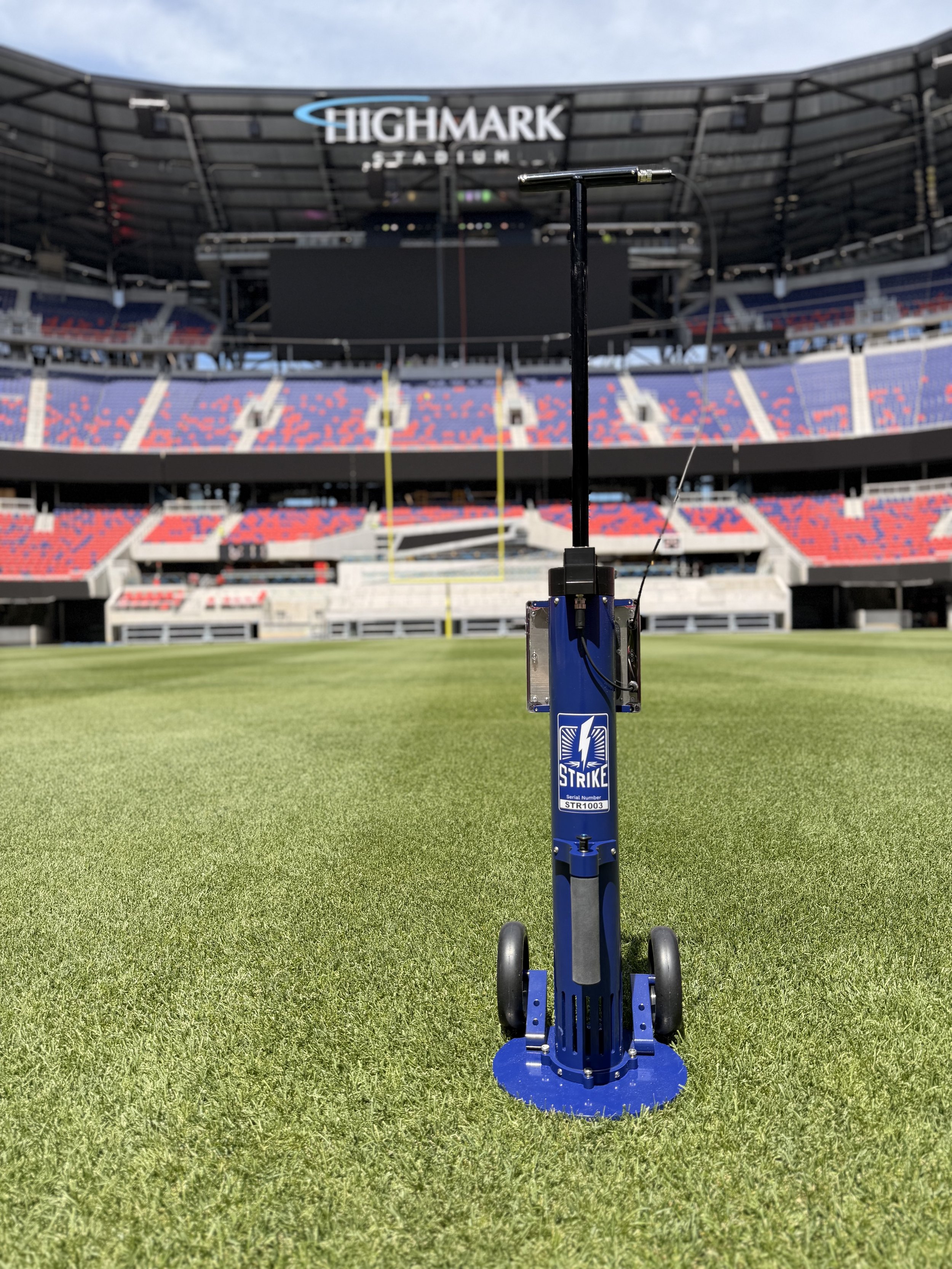
Critically, the new standard was engineered around biomechanical validation rather than convention. Finite element modelling of both real athlete impacts and the STRIKE apparatus was used to tune the device's structural response to match actual player loading conditions — a marked departure from earlier test methods that weren't designed with cleat-level player mechanics in mind. The compliance criterion is explicit: an average peak g between 45g and 90g, tested within 72 hours of kick-off (and no later than 24 hours prior) for outdoor gameday fields, and within 72 hours for indoor fields.
Traction Gets Its Own Standard, for the First Time
Hardness has never told the whole story of player-surface interaction, and the Mandatory Practicesacknowledge that directly with MP 4: Cleat-Surface Traction Testing. The new instrument here is the BEAST (Biocore Elite Athlete Shoe-Surface Tester), which uses a hydraulic piston and an NFL-specific cleat form to apply translational and rotational loads at magnitudes and rates consistent with elite player movement, drawing on more than a decade of published biomechanics research (Kent et al., 2011, 2012, 2015). BEAST testing is now mandatory on all U.S.-based synthetic turf game fields at least monthly during the season, capturing peak shear force, peak torque, and displacement metrics that inform both compliance and, eventually, product-level screening.
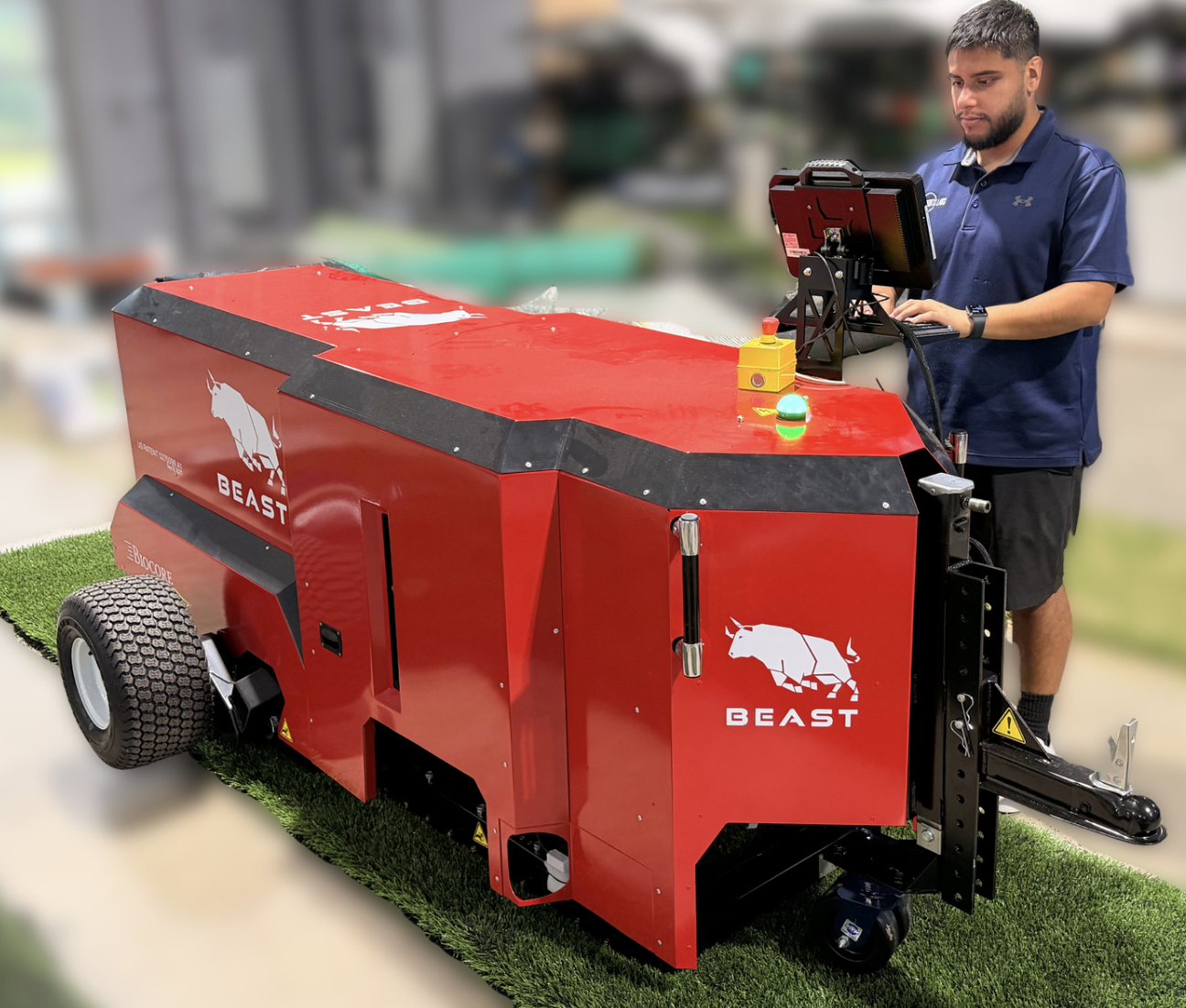
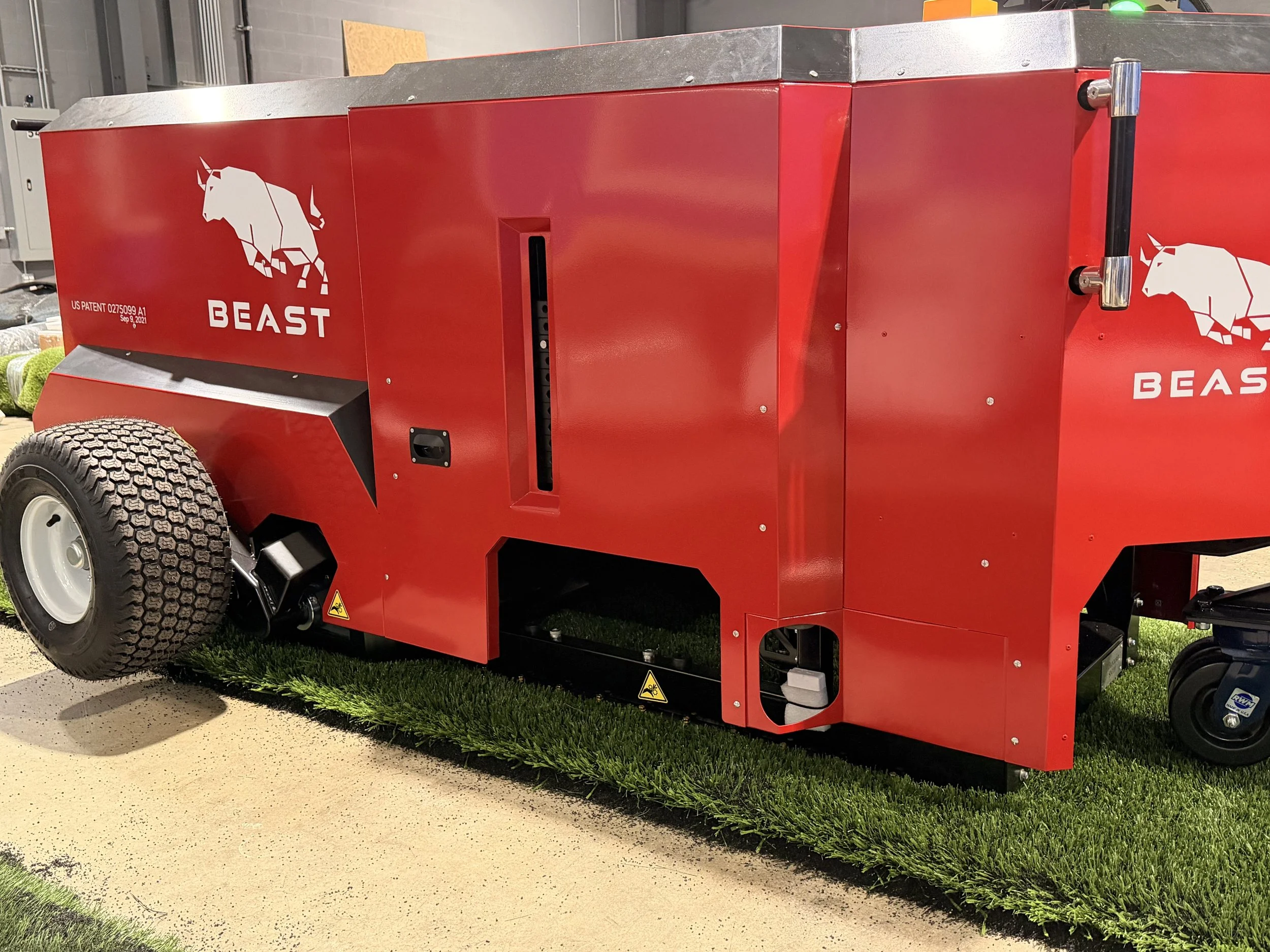
Notably, traction doesn't yet carry a defined gameday pass/fail threshold — that's expected to develop as the league accumulates a season's worth of standardized data. But the direction is clear: beginning with the 2026 season, new synthetic turf installations will require advance product approval tied to specific STRIKE and BEAST thresholds (peak torque ≤180 Nm; peak g between 45g and 90g) before a product can even be installed.
What This Means for the People Managing the Turf
For field managers, the practical implications are substantial. Testing now requires certified equipment supplied directly by the league, standardized operator training, defined on-field test patterns (STRIKE runs "across the field," BEAST runs "down the field" to minimize surface traffic), and mandatory data upload via Wi-Fi to a centralized dashboard — shifting recordkeeping from local logs to league-wide visibility in near real time. Remediation pathways are also built into each Mandatory Practices, so an out-of-range reading isn't just a compliance flag; it triggers a defined corrective process.
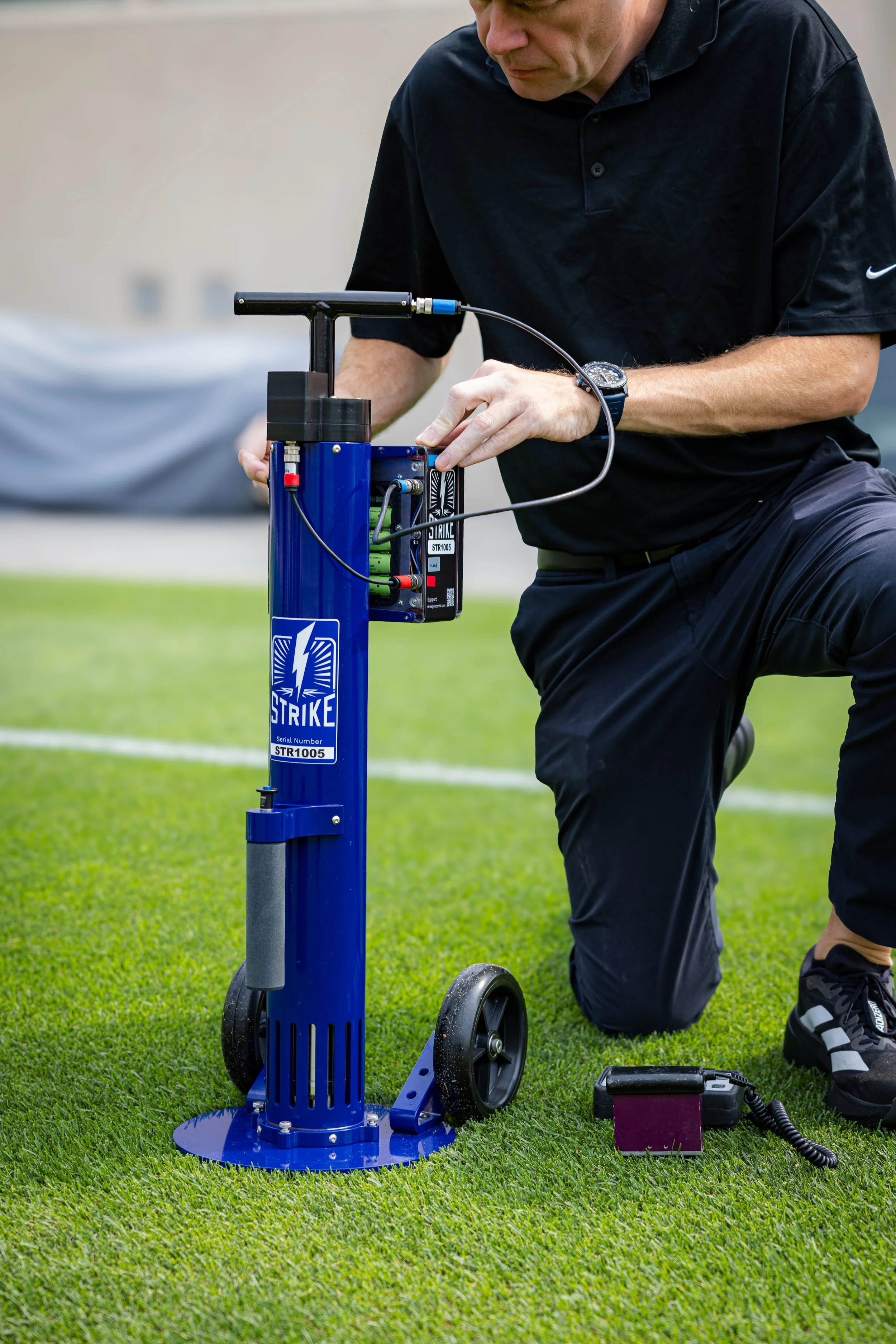
The broader significance is less about any single number and more about what the framework represents: a move from a decades-old, largely uniform hardness metric toward a multi-instrument, biomechanically grounded system that treats hardness, traction, moisture, and infill consistency as interdependent variables — all monitored on the same cadence, across every surface a player will encounter.
For an industry that has operated under a single hardness benchmark since the Gmax era began, that's not an incremental update. It's a new operating standard for what "safe and consistent" means on an NFL field — and one that every turf manager, sod supplier, and synthetic turf manufacturer serving the league will now be building toward.